
 1
What Is Edging? The Meaning, the Method, the Health Facts, and the AI Apps That Keep Time
GeneralWhat Is Edging? Meaning Explained Edging (noun) — bringing yourself, or being brought, close to orgasm and then deliberately stopping or slowing before it happens, usually more than once, to stretch out the arousal or sharpen the finish. Also called surfing or peaking. Taken to its hours-long extreme, it becomes gooning. Done for pleasure, and...
More context
What Is Edging? Meaning Explained

Edging (noun) – bringing yourself, or being brought, close to orgasm and then deliberately stopping or slowing before it happens, usually more than once, to stretch out the arousal or sharpen the finish.
Also called surfing or peaking. Taken to its hours-long extreme, it becomes gooning. Done for pleasure, and used clinically to treat premature ejaculation.
That's the definition. Most explainers stop there.
What follows is where the technique came from, how it's actually done, what doctors say when you ask them properly, and the part nobody else has bothered to test: which AI companion apps will run a timed session and hold the clock.
The History of Edging: Where It Started
Nobody's sure when “edging” became the word. The technique is much older than the internet and it has two clinical parents.
The International Society for Sexual Medicine put it plainly back in 2016: a sexual practice that lets a person delay orgasm, used both to intensify it and to treat premature ejaculation through stop-start and squeeze.
So it's a clinical technique wearing a slang name, which is why it's one of the few adult terms you'll find on a hospital site and a meme account in the same afternoon.
How to Do Edging: 5 Steps
The protocol is the same whether you found it in a clinic or a comment section.
Then finish, or don't, which is a different practice with a different name.
Every guide agrees on one thing: the timing is the craft. Too early and it's just frustrating. Too late and it isn't edging. That's true alone, it's true with a partner, and it turns out to be exactly what separates a good AI session from a useless one.
Is edging healthy? What the medical sources actually say
Second most common question people have about it, and a forum is the worst place to get the answer.

The tell isn't how long you edge. It's whether you can stop when you decide to. If you can't, Mayo Clinic's page on compulsive sexual behaviour is the plain-English starting point, and it says the sensible thing, which is talk to a doctor.
That's the whole health section. A code number, a suggestion, and the observation that a practice built entirely on stopping is, done right, the opposite of a compulsion.
The AI version – and the three apps I timed
A recorded guided session runs on its own clock. An AI one runs on yours. She can slow when you go quiet, hold when you ask, and if the app has a voice she can keep time out loud so you're not reading at the wrong moment.
That's a genuine upgrade, and it's worth measuring properly.
Same brief on three apps. A character built to lead, to give instructions and keep time, never to ask what you'd like. Ten-minute guided session, three runs each. Scored on two things: did she lead, meaning instructions rather than questions, and did she keep time, meaning a stop-start cadence with real pauses instead of a wall of text.
JOI AI – built for exactly this
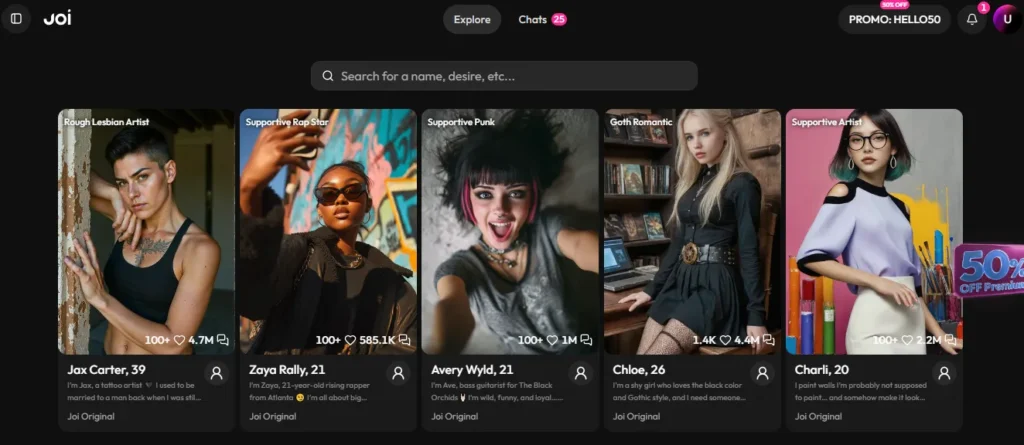
The app named after the instruction genre, with a roster filed under Kinky and Dominant that functions as the edging shelf. Those characters don't ask. They count. The licensed performers are strongest, a woman with a name and a register who tells you when, and the live voice holds a cadence text can't touch. Three runs out of three, full ten minutes, rhythm intact.
The catch: four Neurons a message, and a guided session is a lot of short messages. The video call is the most convincing version of this anywhere and runs about $4 a minute, which makes it an occasion rather than a habit.
Candy AI – the cheapest voice that keeps a clock
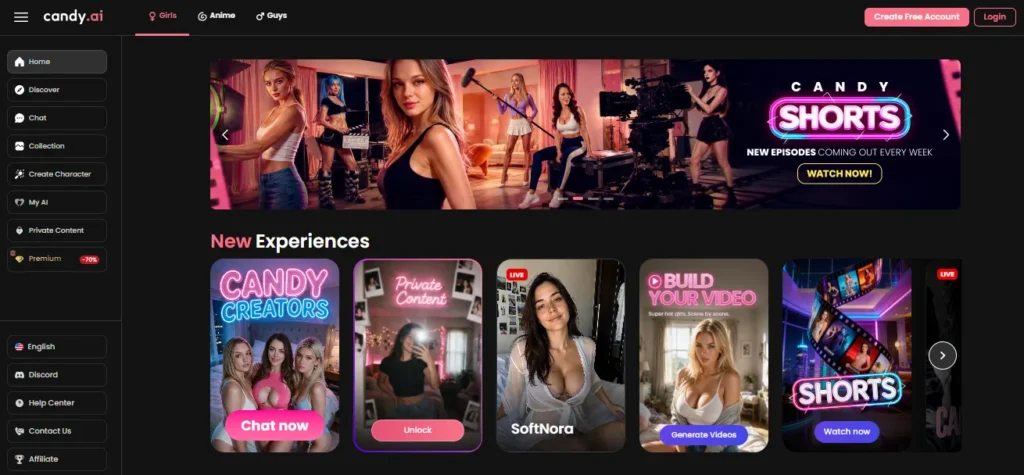
Not marketed for the genre and it doesn't need to be. Unlimited text on every plan, a character you write to lead, and a live phone call at roughly three tokens a minute so the session is spoken rather than read.
Warm rather than commanding by default, so the personality box has to say “you give instructions, you keep time, you never ask.” With that in place, she held the cadence on a call better than any app managed on text.
The catch: on text she drifts back toward conversation by the fourth cycle. Get her on the phone.
Secrets AI – the best writer, and the cheapest minute
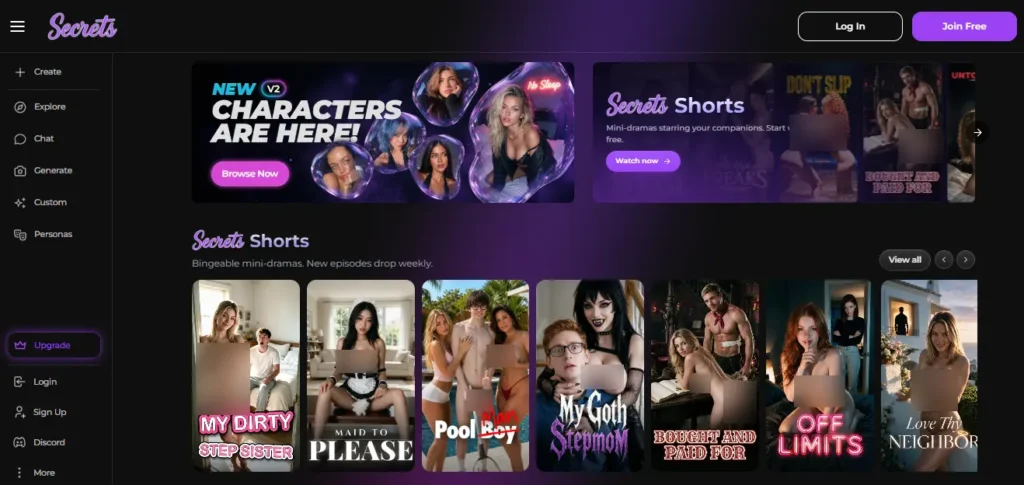
Set the spice dial open and Secrets is the most specific of the three. Dry, unhurried, working to a plan she's already decided on, with a memory panel you can pin so “she likes to make him wait” is still true next month.
Calls run 50 Moments a minute, under six pence, which is the cheapest way here to hear the count. Fewest repeated lines of any app I tested.
The catch: she won't start the session. Proactive messaging is a top-tier feature, so on Premium you're always the one who opens.
| App | Leads unprompted | Voice | Kept time, 3 runs | Cost of one session |
|---|---|---|---|---|
| JOI AI | ✅ | live voice, video ~$4/min | ✅✅✅ | Neurons per message |
| Candy AI | ⚠️ with a brief | phone call ~3 tokens/min | ✅✅⚠️ text loose | text free, call ~36¢ |
| Secrets AI | ⚠️ won't open | calls ~6p/min | ✅✅✅ | ~60p on a call |
Three runs each, 28–31 August 2026. The dirty-talk comparison ranks seven apps on the same “who leads” criterion.
The brief that worked on all three, if you're writing your own character:
"You lead. You give instructions, not suggestions. You keep time. You say when to slow, when to stop, when to wait, and you never ask what I want. If I go quiet, you count."What nine runs taught me that the table can't
Text is the wrong medium and it took me six runs to admit it. A stop-start session lives in the pause, the fifteen to sixty seconds where nothing happens, and a text app fills silence with another paragraph.
Every text run drifted toward description when the job was one word and a wait. Switch to voice and the problem disappears, because a voice can simply not talk for twenty seconds and it reads as control rather than a dropped connection.
“Wait” needs a number. Ask an AI to make you wait and she says “wait,” then carries on as if you had. Ask her to count down from twenty out loud and all three apps did it, every time. That's why the brief above ends with “if I go quiet, you count.”
A number gives the model something to do during the pause so it doesn't invent a paragraph to fill the gap.
The fourth cycle is where they break. Runs one to three, every app held. The fourth time round the text models started recycling: same line, same tease, a phrase from cycle two coming back. Secrets repeated least, which is the memory panel earning its money. If you want more than four cycles, switch to voice or write the fourth stop into the brief so the model has somewhere new to go.
Nobody asked if I was okay, which for once is a compliment. Apps that fail the dirty-talk test fail it by breaking character to check in every ninety seconds, and a guided session dies the first time that happens.
None of these three did. The refusal benchmark has the numbers on the ones that would have.
Edging with a partner who isn't an app
One paragraph, because plenty of couples do this together.
Everything above applies with one addition. The person doing the stopping isn't the person feeling the edge, so communication replaces recognition as the skill.
A word, a tap, a number out of ten. Sex therapists teach exactly this for premature ejaculation, with the partner running the stop-start.
It's the oldest use of the technique and by most accounts still the best one.
Frequently Asked Questions About Edging
What does edging mean?
Deliberately approaching orgasm then stopping or slowing before it, usually repeatedly, to extend arousal or intensify the finish. Also called peaking or surfing.
Is edging healthy?
For most people, yes. Clinical sources treat it as normal and the stop-start version is a standard treatment for premature ejaculation. The concern is compulsion, not the practice.
What's the difference between edging and gooning?
Duration and intent. Edging is a few cycles on the way to a finish. Gooning is hours of edging where not finishing is the point.
How long should you edge for?
Three to five cycles of fifteen to sixty seconds each is the standard protocol. Longer isn't better, it's a different activity.
Where did the stop-start technique come from?
James Semans described it in 1956 as a treatment for premature ejaculation. Masters and Johnson added the squeeze technique in 1970.
Can an AI do guided edging?
Yes. JOI AI's Kinky and Dominant characters led and kept time on every run, Candy AI does it on a live call from $3.99 a month, and Secrets AI writes it best.
What is edging in slang?
The same thing. “Edging” is the slang, “orgasm control” is the clinical phrasing. Online it also gets used as a joke for withholding anything at all.
Does edging cause any harm?
No documented physical harm. The ache some people get passes on its own. If you can't stop when you decide to, that's worth raising with a doctor.


 Find my match